
Intelligence, in house.
A self-hosted assistant for your documents and agents. No cloud or internet required.
Private AI that runs on your network
- Ollama
- LM Studio
- LocalAI
- KoboldCPP
- Docker
- Kubernetes
- Helm
- OpenShift
- Model providers
- 38
- Vector databases
- 10
- Embedding engines
- 14
- Deployment methods
- 5
Ready on day one.
Equipped for the mission.
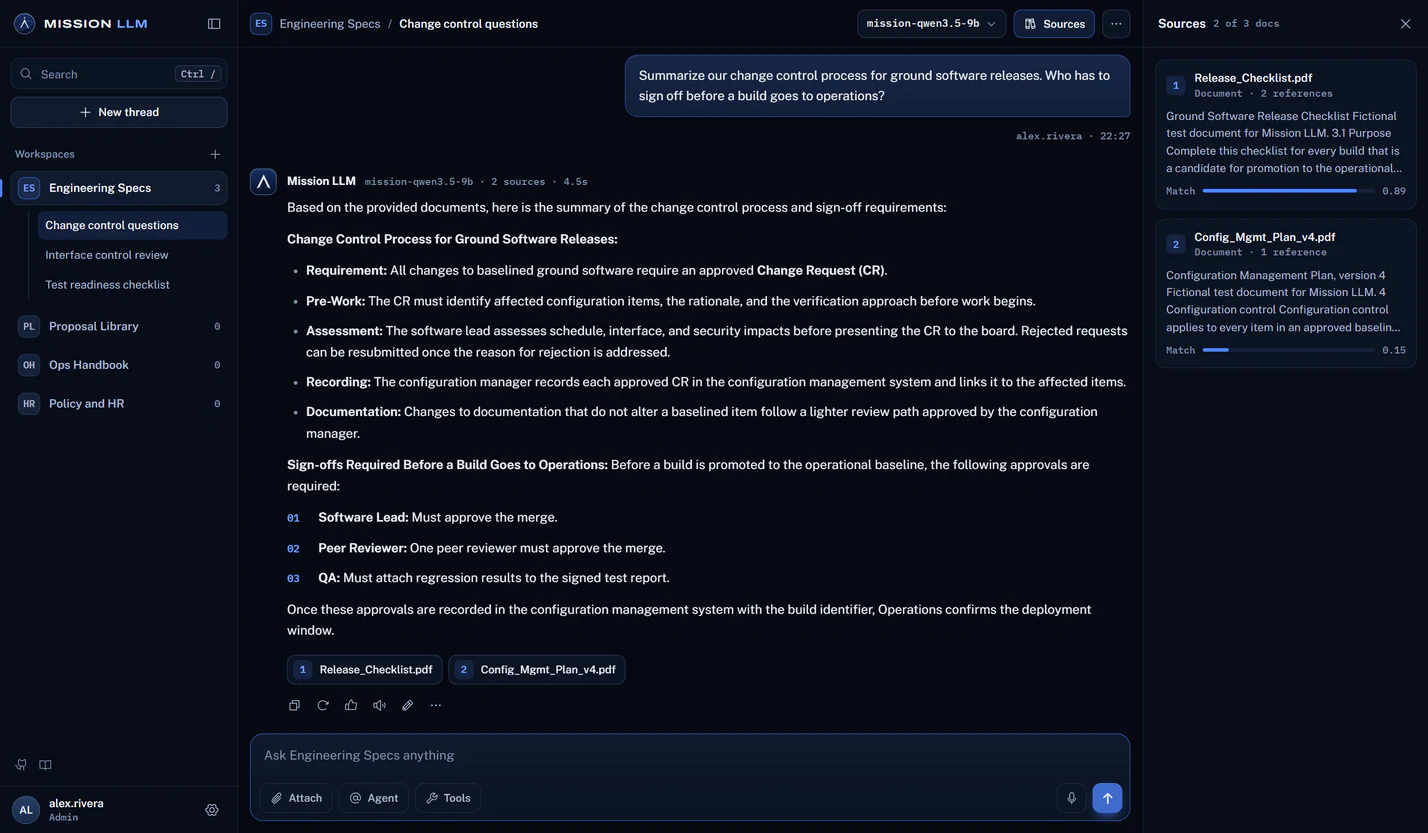
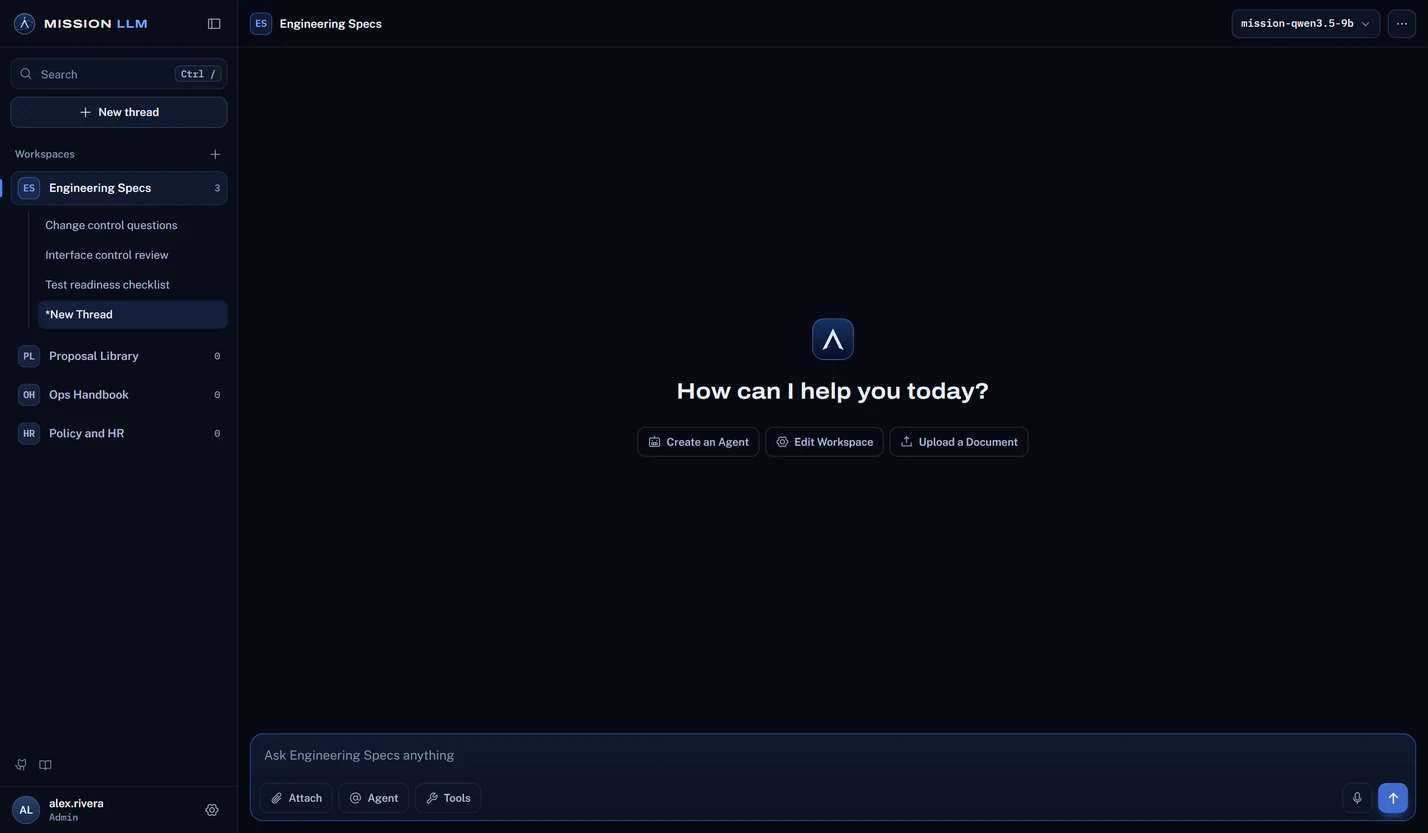
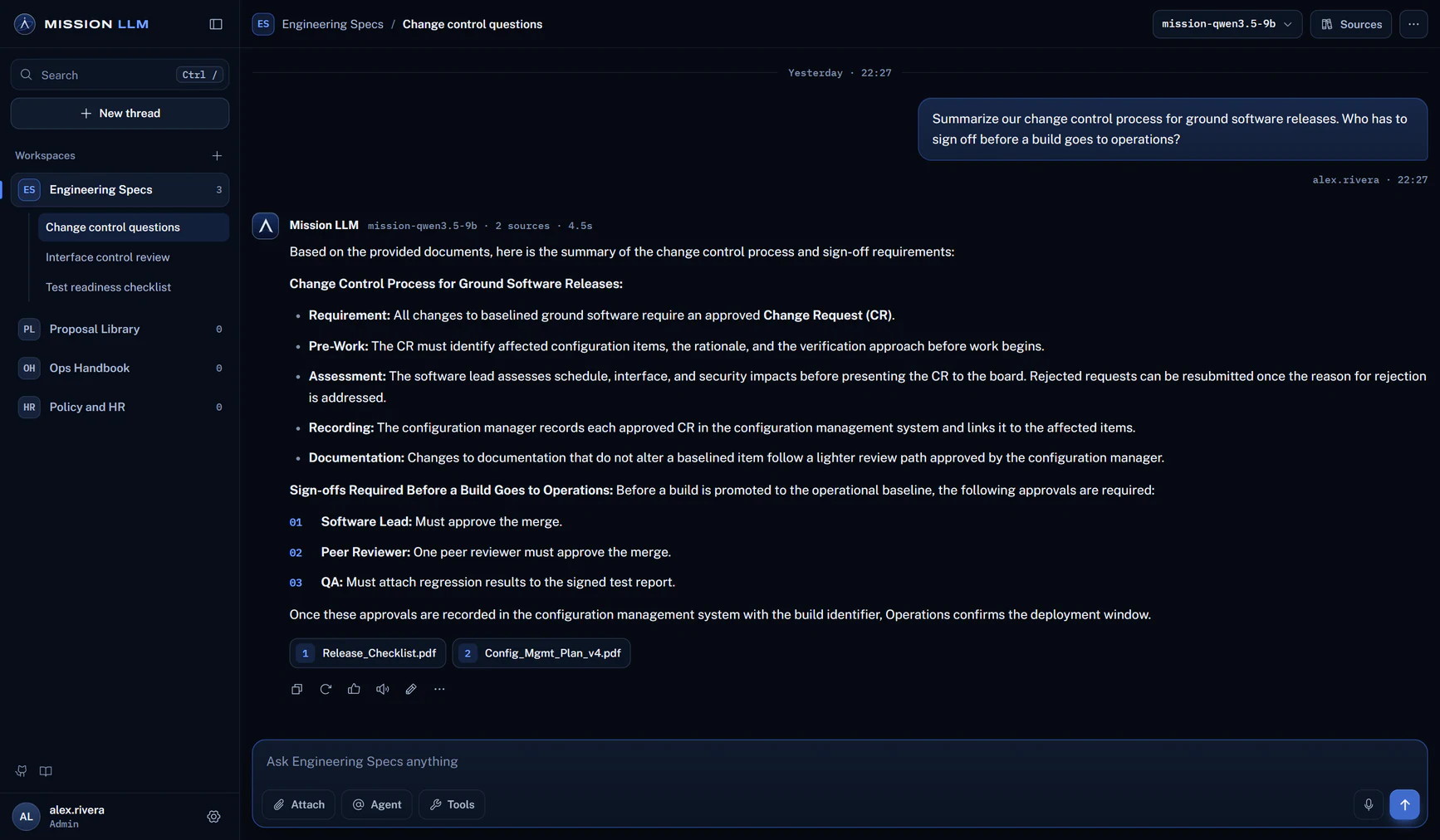
Files you add are parsed and indexed on your server. Answers drawn from them list their sources.
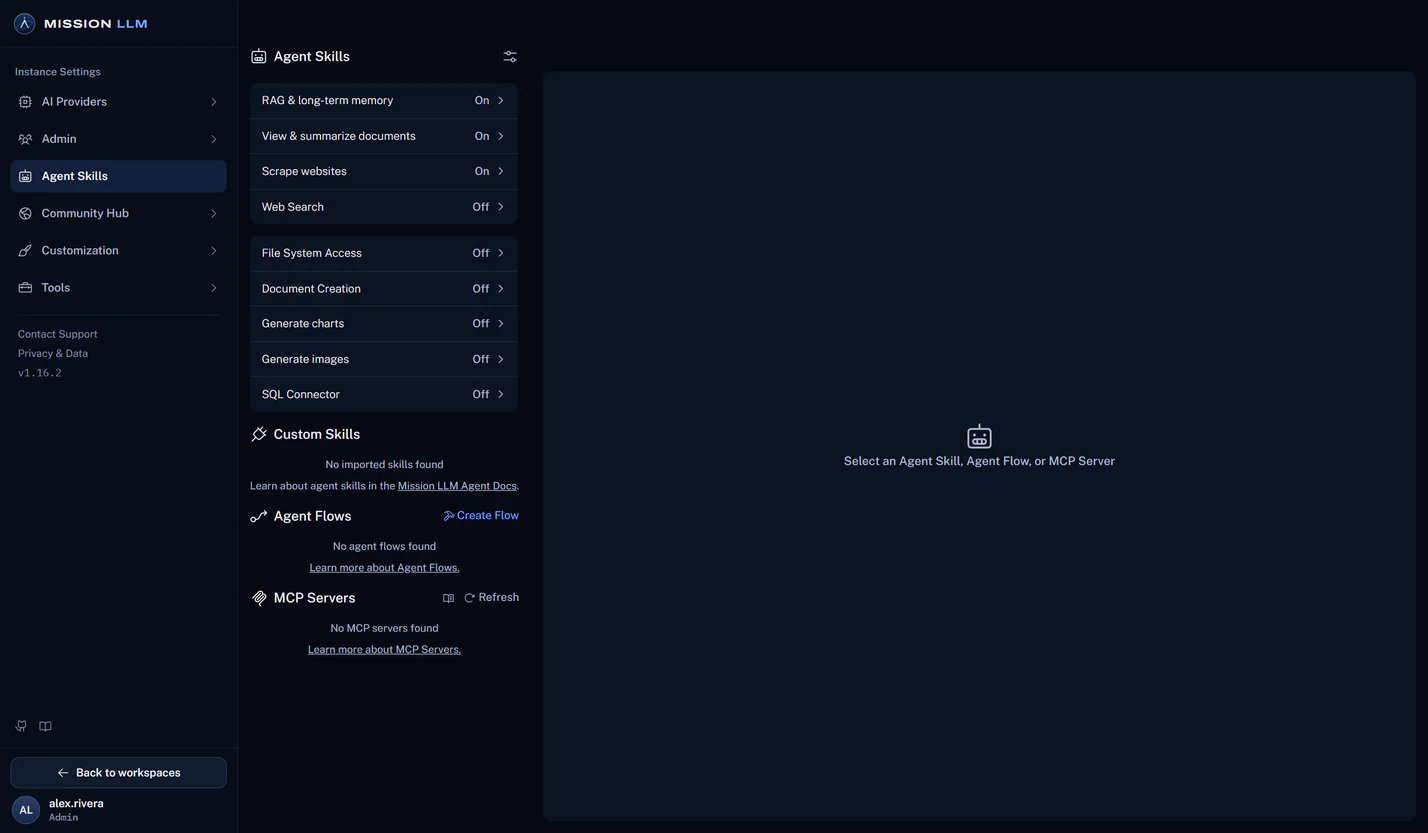
Type @agent to hand off a task. Agents use the skills and MCP servers your admins turn on.
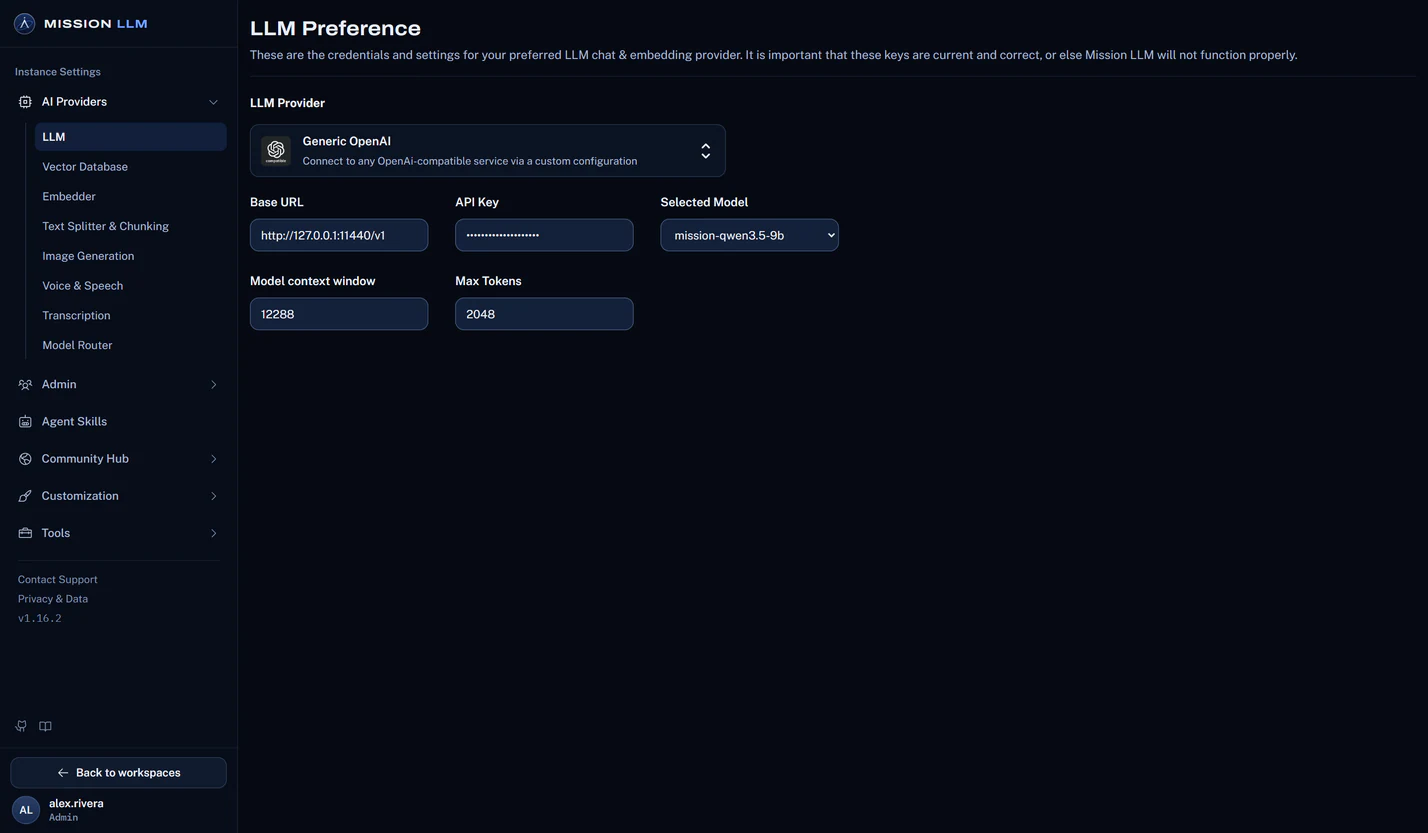
Pick from 38 model providers, local or cloud, and set a different one for each workspace.
Each workspace keeps its own documents, prompt and model. Threads keep lines of work apart.
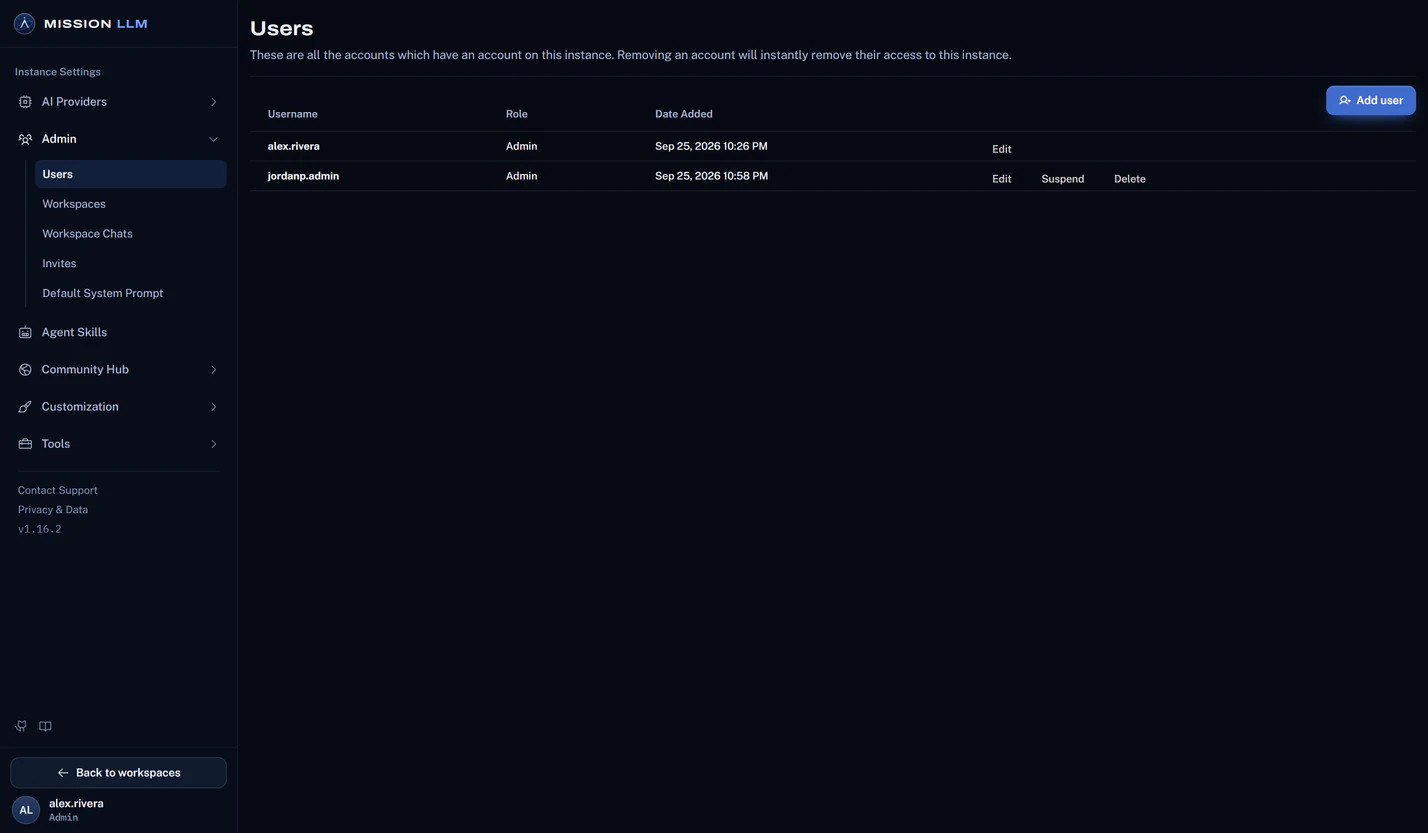
In multi-user mode, everyone signs in with their own account and an admin, manager or default role.
Grounded answers
Answers you can trace.
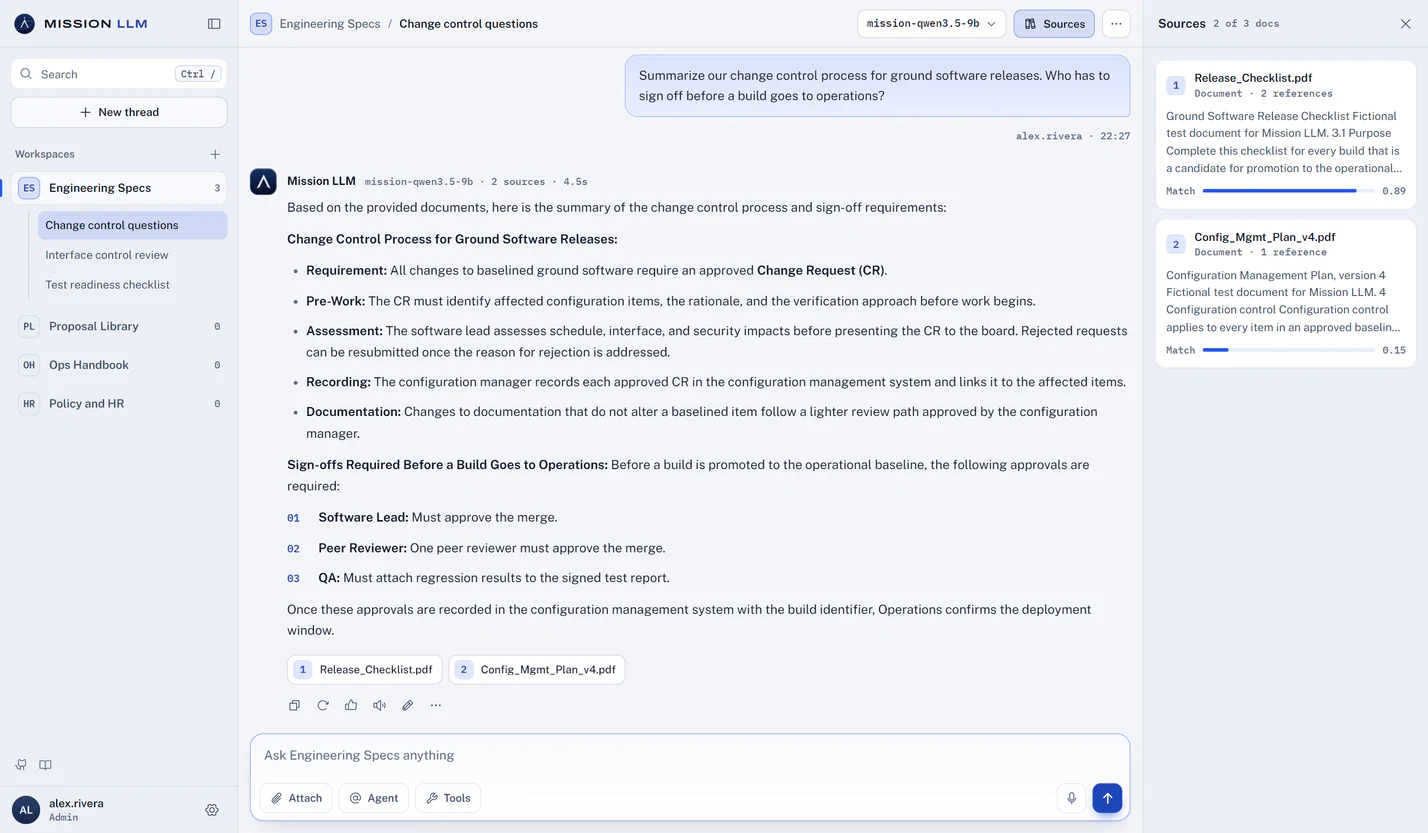
When a workspace has documents, Mission LLM searches them before the model answers. Open Sources on an answer to see the documents it used, the passages it retrieved and how closely each one matched.
- Sources listed under grounded answers
- Retrieved passages with match scores
- A similarity threshold per workspace
Security and control
You set the boundary.
Pair it with a local model runtime and stage the built-in models. Chat, embeddings and search then run offline.
In Docker, bind the published port to 127.0.0.1 (-p 127.0.0.1:3001:3001) and only that machine can connect.
Admin, manager and default roles, with workspace membership. Admins issue and revoke keys for the developer API.
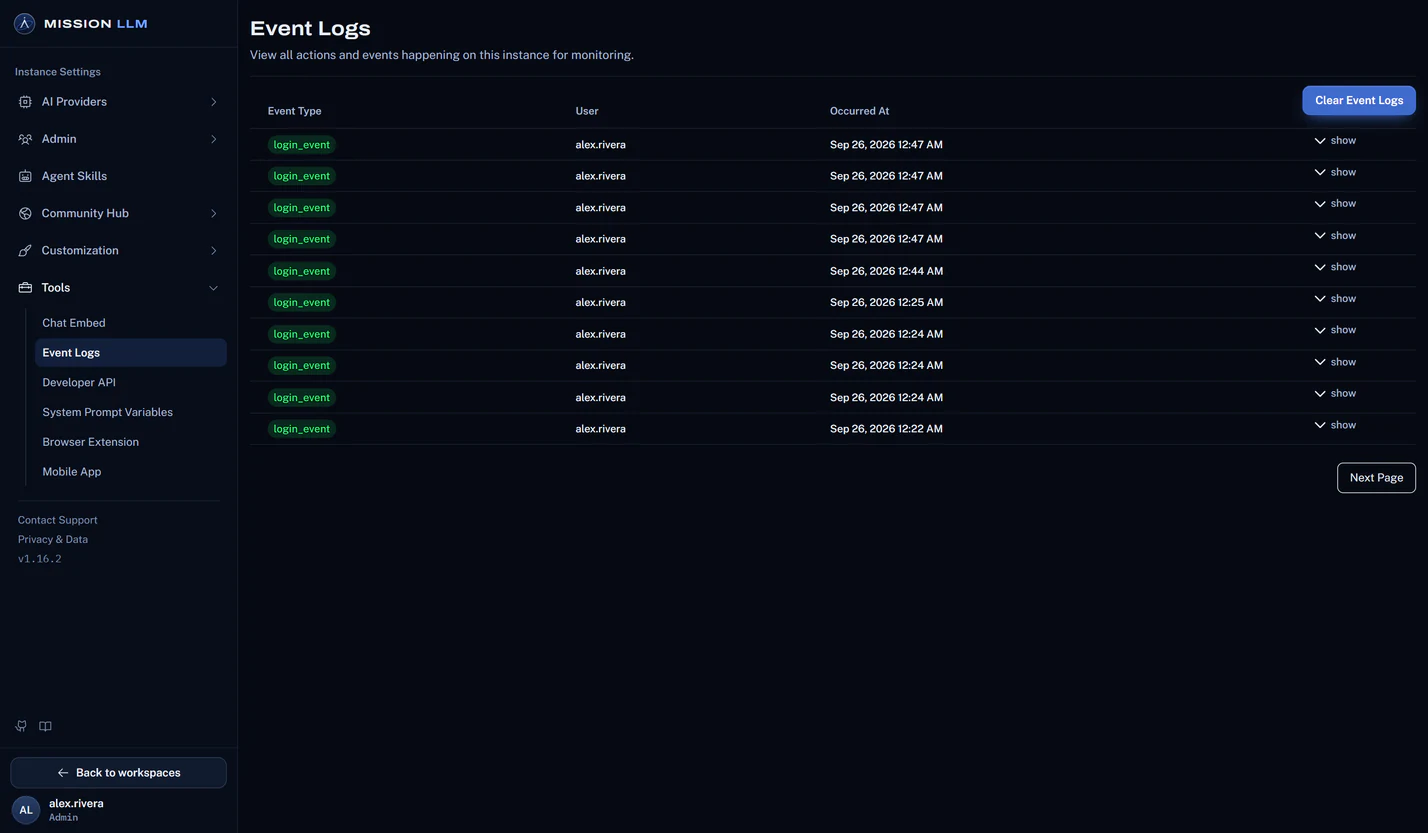
Sign-ins, failed sign-ins, and changes to users, API keys, invites, workspaces and documents, in one log for admins.
Set DISABLE_TELEMETRY="true" before the first start and no usage events are sent. Admins can also turn it off in Settings.
Four steps from install to answers.
- 1
Install with Docker

One container serves the app and API on port 3001, with your data in one storage folder.
- 2
Connect a local model

Point it at Ollama, LM Studio or another runtime on your network. Cloud providers work too.
- 3
Add your documents

Drop files into a workspace. Mission LLM parses, embeds and indexes them on your server.
- 4
Invite your team

Turn on multi-user mode, invite people, and give each person a role and workspaces.
Self-hosted
Deploy it where your data already lives.
Mission LLM ships as one container that serves the app and API on port 3001. Run it with Docker, Compose, Kubernetes, Helm or OpenShift, on a workstation, a server in your rack or a cloud account you control.
export STORAGE_LOCATION=$HOME/missionllm && \
mkdir -p $STORAGE_LOCATION && \
touch "$STORAGE_LOCATION/.env" && \
docker run -d --rm -p 3001:3001 \
--cap-add SYS_ADMIN \
-v ${STORAGE_LOCATION}:/app/server/storage \
-v ${STORAGE_LOCATION}/.env:/app/server/.env \
-e STORAGE_DIR="/app/server/storage" \
REGISTRY/mission-llm:latest Resources
See where your data goes and which controls ship today.
A plain-language data flow, every outbound connection and how to avoid it, and seven steps to harden an install.
Install it on one workstation or a whole cluster.
Build the image from source, then run it with Docker, Docker Compose, Kubernetes, Helm or OpenShift.
Start free, and add support when you need it.
Community is the full application, free to self-host. Enterprise adds planned support, deployment help and governance features.
MIT licensed foundation.
Open at the core. Yours to run.
Mission LLM is built on the open-source AnythingLLM project (MIT License) and adds what an organization needs to run it with confidence.
- License
- MIT
- User roles
- 3
- Cloud templates
- 3
In-place upgrade from AnythingLLM
The database, settings and vector collections carry over.
Documented outbound connections
Every connection the server can make, and how to avoid it.
Templates that pull only your image
Deployment templates run the image you build and host.
AnythingLLM core (MIT License)
- Ingestion
- Retrieval
- Agents
- Providers
Stand it up on your own hardware.
Start with one container and a local model. Add users, workspaces and documents when you are ready.